


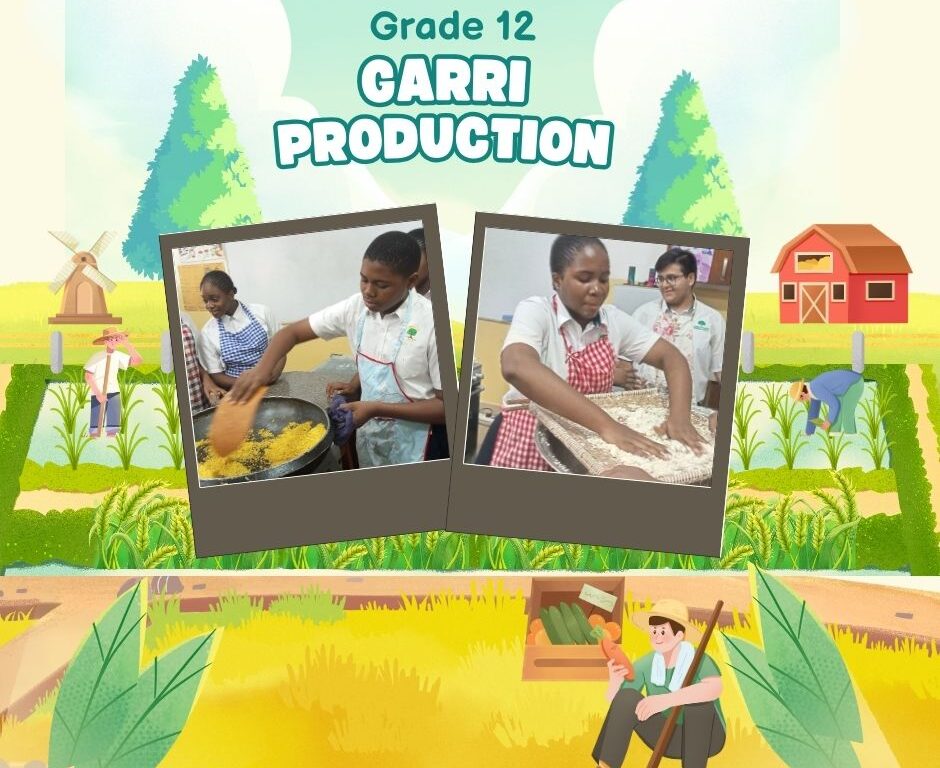
Recently, our Grade 12 students explored how to make Garri through a hands-on learning experience that extended beyond the classroom. Using cassava grown and harvested on the school farm, they discovered how this staple food is transformed from raw tubers into the final roasted product. As a result, they gained practical insights into food processing and agriculture.
The Garri used in this activity came directly from the school farm, providing students with a complete farm-to-table experience. They learned about each step in the Garri production process, which included:
-
Sorting & Washing – selecting quality cassava roots and cleaning them thoroughly.
-
Peeling – removing the outer skin of the cassava tubers.
-
Grating/Milling into Pulp – breaking down the cassava into a fine pulp.
-
Fermentation – allowing the pulp to ferment for sourness and cyanide reduction.
-
Dewatering/Pressing – removing excess water from the fermented pulp.
-
Sieving – ensuring a uniform texture for frying.
-
Frying/Roasting – roasting the pulp (often with palm oil for yellow Garri) to achieve the desired flavour and texture, followed by cooling and packaging.
Under the guidance of their teacher, students actively participated in all stages of making Garri, gaining practical exposure to each step of the process.
This practical activity strengthened students’ understanding of agricultural science, food processing, and entrepreneurship. In addition, it highlighted the cultural significance of Garri in Nigerian cuisine. By engaging with the production cycle firsthand, students developed valuable skills in teamwork, observation, and practical problem-solving.
Overall, experiences like this at Greenoak International School empower students to appreciate the journey from farm to table. Furthermore, they help students build skills that prepare them for both academic and real-world challenges.